As an Amazon Associate, we earn from qualifying purchases. Some links on this site are affiliate links at no extra cost to you. Our recommendations are based on thorough research and editorial judgment.


How Metal Detectors and Security Checks Influence Toe Cap Choice

Metal detectors impact toe cap choice by requiring footwear that passes security checks without triggering alarms. Steel toe caps contain metal that often sets off detectors, causing delays. Composite toe caps, made from carbon fiber, fiberglass, or Kevlar, offer similar protection but do not interfere with metal detectors. Industries like aviation and military favor composite boots for quicker screening and compliance. When selecting safety footwear, consider your work environment’s security protocols and the ASTM safety standards. Further details can clarify which option best suits your needs.
Key Takeaways
- Metal detectors often trigger alarms with steel toe caps, causing delays and complicating security compliance at checkpoints.
- Composite toe caps, being non-metallic, allow smooth passage through metal detectors, reducing wait times and enhancing work efficiency.
- Environments with strict security, like airports or military bases, favor composite toe boots to comply with metal detection protocols.
- ASTM F2413 standards ensure composite toe caps provide impact protection comparable to steel without metal detection issues.
- Industries requiring contamination-free or explosive-sensitive workspaces mandate metal-free toe caps to ensure swift security clearance.
Role of Metal Detectors in Workplace Safety
Although metal detectors serve primarily to identify unauthorized metallic objects, they also affect footwear choices in security-sensitive workplaces. What role do metal detectors play in workplace safety? They screen individuals at security checkpoints to prevent the entry of dangerous metal items. How does this influence protective footwear? Traditional steel toe work boots can trigger alarms due to their metal caps, causing delays and compliance challenges. What alternatives exist? Composite toe caps, made without metal, allow workers to pass through detectors smoothly without sacrificing protection. What standards guarantee safety? Compliance with guidelines like ASTM F2413 ensures that both composite and steel toe boots meet safety requirements, maintaining workplace safety. In industries with strict metal detection, choosing composite toe caps enhances efficiency and adherence to security protocols. Additionally, footwear incorporating Kevlar midsole provides enhanced puncture resistance, combining safety with comfort for workers in hazardous environments.
Materials Used in Composite Toe Caps

Composite toe caps use various non-metallic materials that serve as safe and effective alternatives to steel or aluminum. What materials are commonly used in composite toe caps? These include carbon fiber, fiberglass, plastic, and Kevlar. How do these materials guarantee safety and protection? They provide impact resistance and compressive strength similar to traditional metal toe caps. Why choose composite materials for metal detection environments? Because they do not trigger metal detectors, making them suitable for workplaces like airports and secure facilities. What other benefits do composite materials offer? They are lighter, reducing fatigue, and provide better thermal insulation for added comfort. Though sometimes more expensive, composite toe caps balance safety, protection, and metal detection compatibility effectively, meeting industry safety standards while enhancing wearer experience. It is also crucial to confirm compliance with ASTM F2413 standards to ensure the composite toe caps provide adequate impact and compression resistance.
Comparison of Metal and Composite Toe Caps in Security Settings

When choosing between metal and composite toe caps in security-sensitive settings, consider their impact on metal detection systems and workplace compliance requirements. How do composite and steel toe caps compare at security checkpoints?
- Composite Toe caps are metal-free and non-conductive, allowing easy passage through metal detectors without triggering alarms.
- Steel Toe caps contain metal, often setting off metal detectors, which can cause delays and additional screening.
- Both types provide strong impact resistance, meeting ASTM compliance standards for workplace safety.
- Composite Toe boots are preferred in environments requiring frequent security checks, such as airports and government buildings, due to their seamless compatibility.
- Steel Toe boots may hinder compliance in these areas despite their durability.
Choosing composite toe caps supports operational efficiency and safety compliance without compromising protection at security checkpoints. Additionally, composite toe caps contribute to lightweight designs that reduce fatigue during extended wear.
Industries That Require Metal-Free Safety Footwear

Why do certain industries require metal-free safety footwear? Many industries choose metal-free composite toe boots to guarantee smooth passage through metal detectors during security checks. This type of safety footwear provides protection against impact while avoiding alarms triggered by metal components. Key industries include:
- Aviation and aerospace, where passing security checks quickly is vital.
- Logistics and delivery, needing compliance with airport regulations.
- Government and military security, where non-metallic materials aid seamless metal detector screening.
- Electronics manufacturing and cleanrooms, which require contamination-free footwear.
- Workplaces near explosives or sensitive equipment, where metal detection rules are strict.
In these industries, metal-free composite toe shoes combine safety footwear protection with compliance, enabling workers to meet workplace security needs effectively. Additionally, the use of water-resistant materials in many models adds practical advantages in diverse work environments.
Standards Governing Toe Cap Safety Materials
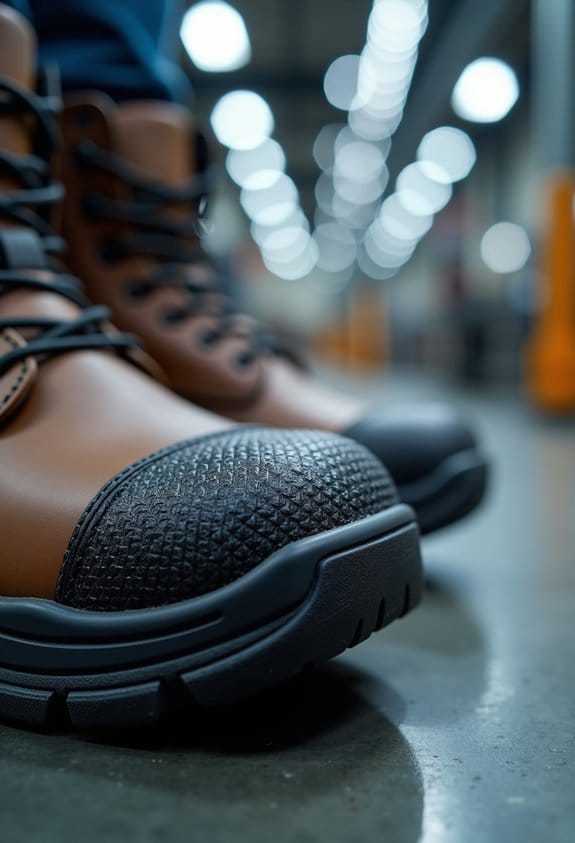
Safety footwear manufacturers must follow strict guidelines to guarantee toe caps protect wearers from workplace injuries while meeting industry and security requirements. What standards govern toe caps in safety footwear? Primarily, ASTM F2413 sets rigorous rules for impact and compression resistance. Toe caps must withstand at least 75 pounds of impact and approximately 1,750 pounds in compression tests. Why are composite materials important? These non-metallic toe caps comply with CSA Z195 standards, ensuring safety equal to steel variants but without triggering metal detectors. How should you choose your safety footwear? Understand the specific ASTM and CSA standards relevant to your workplace hazards and metal detection protocols. This approach helps balance protection with security needs, ensuring the footwear performs reliably without causing false alarms during safety checks. Additionally, considering boots with ASTM F2413 safety compliance guarantees both impact protection and adherence to essential safety regulations.
Impact Resistance of Composite Toe Caps
Impact resistance is a critical factor in selecting composite toe caps for safety footwear, as these components must protect your feet from sudden forces and heavy falling objects. How do composite toe caps meet safety requirements?
- They provide impact protection equivalent to steel, withstanding between 125 and 200 joules of force.
- Made from non-metallic materials like carbon fiber and fiberglass, composite toe caps avoid triggering metal detectors, suitable for sensitive environments.
- Compression resistance is also important; composite caps can endure up to 15 kN of pressure, complying with ASTM F2413 standards.
- Despite their lighter weight, composite toe caps do not compromise on protection but offer added comfort for prolonged wear.
Which environments benefit most? Workplaces with strict metal detection or where lightweight safety gear is preferred find composite options advantageous.
Additionally, composite toe caps contribute to the overall lightweight design of electrical safety boots, reducing strain during extended use.
How Composite Toe Boots Affect Security Screening Efficiency
When entering secured areas where metal detectors are in use, composite toe boots offer clear advantages by preventing unnecessary alarms. How do composite toe boots affect security screening efficiency? Composite toe boots, made from non-metallic materials, do not trigger metal detectors, which reduces delays during security screening. Why does this matter? Workers wearing steel or aluminum toe caps often face longer checks. Composite toe boots maintain equivalent protection against impact and compression while complying with safety standards such as ASTM F2413. What additional benefits do they provide? The lightweight nature of composite materials reduces worker fatigue over long shifts. To sum up, composite toe boots support seamless passage through security without compromising safety, making them ideal footwear where metal detectors are routinely used. Additionally, choosing boots with premium leather and reinforced features ensures durability and comfort even in demanding work environments.
Advantages of Composite Toe Boots in High-Security Environments
Three key advantages make composite toe boots an excellent choice for workers in high-security environments such as airports and government buildings. First, their non-metallic construction lets you pass through metal detectors without setting off alarms, improving security screening efficiency. Second, composite toe boots offer strong impact protection, meeting safety standards like CSA Z195 and ASTM F2413, so you maintain safety without metal parts. Third, their lightweight design reduces fatigue, enhancing comfort during long shifts often required in high-security environments. These boots use advanced materials such as carbon fiber and fiberglass to achieve impact resistance up to 200 joules. If you work in areas with strict security checks, choosing composite toe boots guarantees compliance while protecting your feet effectively and comfortably throughout your shift. Additionally, many models feature ASTM-certified protection to ensure they meet rigorous safety requirements for workplace hazards.
Common Misconceptions About Composite Toe Boots and Metal Detectors
Understanding the benefits of composite toe boots in security-sensitive environments also involves addressing several common misconceptions about their interaction with metal detectors. Do composite toe boots trigger metal detectors? No. Made from non-metallic materials like Kevlar and fiberglass, they typically pass through metal detectors without setting off alarms. Are steel toe caps the only option for impact protection? No. Composite toe boots offer comparable impact protection and meet safety compliance standards such as ASTM F2413. Can all security scanners detect composite toe boots? Occasionally, some scanners might flag them due to design, but generally, these boots provide smoother passage than steel alternatives. To conclude, composite toe boots combine safety compliance with ease of access in security-sensitive environments, challenging outdated beliefs about metal detection and footwear safety. Additionally, composite toes are often lighter than steel, reducing foot fatigue during extended use.
Choosing the Right Toe Cap Based on Security Protocols
How do security protocols influence the choice of toe caps in work environments? When selecting footwear for security-sensitive environments, you must consider how metal detectors affect toe cap choice. Composite toe caps are favored because their non-metallic footwear design prevents triggering alarms at checkpoints. This allows smoother passage through security, saving time and avoiding complications. To choose the right toe caps based on security protocols, follow these guidelines:
- Confirm workplace safety standards to guarantee adequate protection.
- Opt for composite toe caps when metal detectors are in use, such as at airports or government buildings.
- Consider industry-specific rules requiring non-metallic footwear to meet security requirements.
- Balance safety standards with practical needs to avoid hindering mobility through security checks.
Customer Experiences With Composite Toe Boots in Security Checks
When selecting composite toe boots for security-sensitive workplaces, customer experiences provide valuable insights into their practical benefits. How do composite toe boots perform during security checks? Users report that these boots pass through metal detectors without triggering alarms, reducing delays at checkpoints. What makes them preferable for long shifts? Their lightweight design enhances mobility and comfort, which many users appreciate. Do composite toe boots meet safety requirements? Yes, they comply with standards like ANSI and CSA without the extra weight of metal components. What feedback do security personnel share? They highlight reliable protection combined with ease of movement in high-security environments. To summarize, customer experiences suggest composite toe boots offer a practical balance of safety, mobility, and convenience during metal detector screening and security checks. Additionally, selecting boots that meet ASTM F2413 safety standards ensures both protection and compliance in demanding job settings.
Frequently Asked Questions
Will Composite Toe Shoes Set off a Metal Detector?
Composite toe shoes do not set off metal detectors due to their non-metallic materials. Metal detector functionality, detection sensitivity levels, and safety regulations impact footwear choices, balancing comfort vs protection while meeting workplace safety standards and industry-specific requirements.
What Is the Purpose of a Metal Toe Cap?
A metal toe cap stands as a fortress, shielding toes from harm in hazardous work environments. Its toe cap benefits include durability and compliance with industry standards, balancing rugged protection from toe cap materials with essential comfort considerations in safety footwear.
Do Metal Detectors Detect Aluminum Caps?
Metal detection methods commonly identify aluminum caps due to aluminum properties as conductive metals. Security protocols rely on detection technology sensitive to metal, influencing workplace safety decisions. Material comparisons favor composites for seamless foot protection without detection interference.
What Is Better, Steel Toe or Aluminum Toe?
Steel toe advantages include superior durability and cost-effectiveness, while aluminum toe benefits focus on lighter weight, enhanced comfort, and compliance with specific workplace regulations. Weight comparison favors aluminum, but durability differences and price considerations influence final choice.


